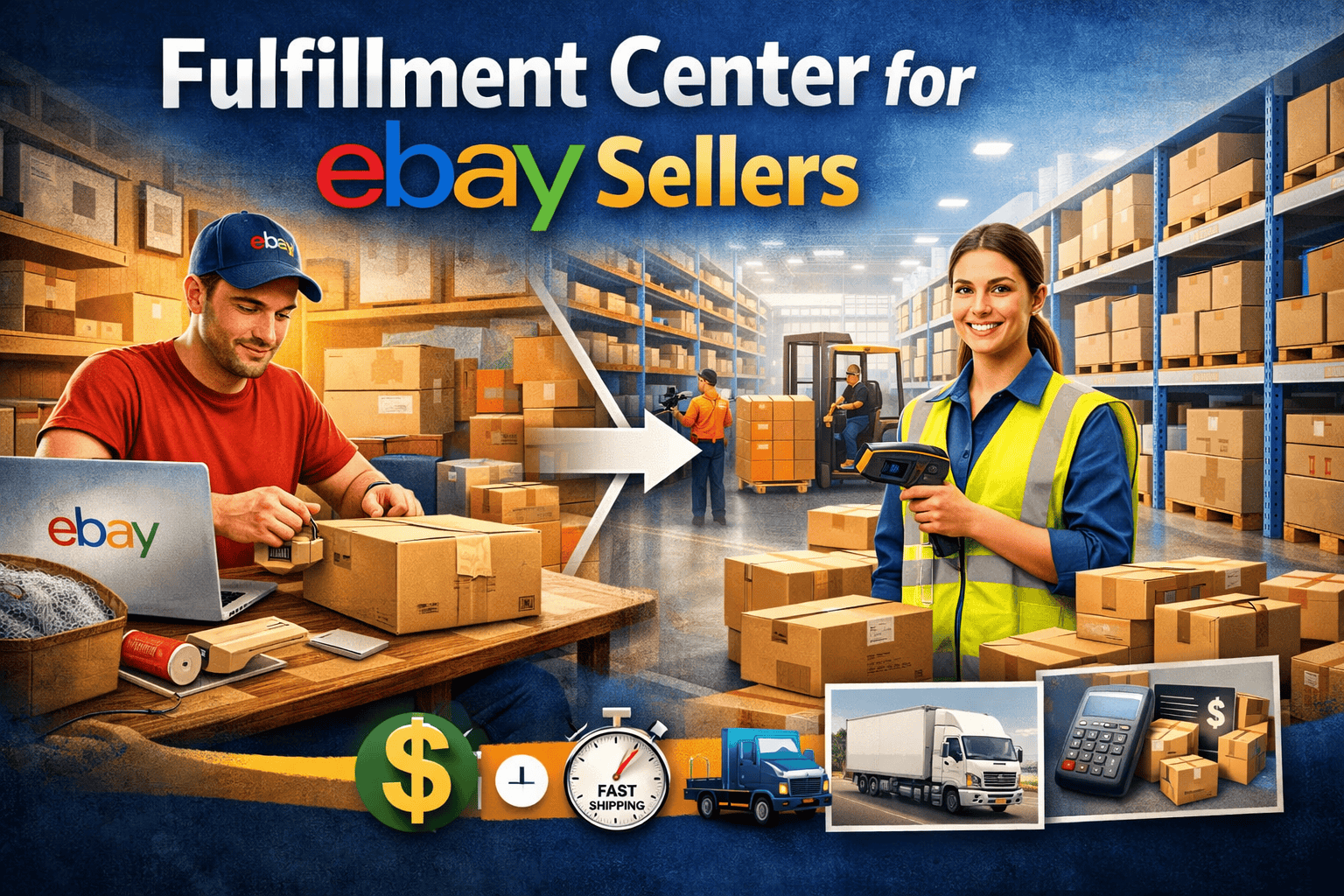
Fulfillment Center for eBay Sellers: Fulfillment vs DIY From a High-Volume Seller’s Perspective
Compare a fulfillment center for eBay sellers vs DIY fulfillment. Learn real costs, profit impact, and when outsourcing makes sense for high-volume sellers.

Updated Feb 13, 2026
|Omri Ross
Fulfillment Center for eBay Sellers: Fulfillment vs DIY From a High-Volume Seller’s Perspective
As an eBay business grows, fulfillment quickly becomes one of the biggest operational challenges. What starts as packing a few orders at home can turn into a full-scale logistics operation involving storage, shipping, labor, and inventory management.
For many serious sellers, this raises a critical question:
Is it better to continue fulfilling orders yourself, or switch to a professional fulfillment center for eBay sellers?
This guide is written from the perspective of a high-volume seller who has managed thousands of monthly orders. It explains how fulfillment centers work, compares them with DIY operations, analyzes real costs, and shows when outsourcing becomes the smarter long-term strategy.
Understanding What a Fulfillment Center for eBay Sellers Does
A fulfillment center for eBay sellers is a third-party logistics provider that stores inventory and ships orders on your behalf. Instead of keeping products in your home or warehouse, sellers send bulk inventory to the fulfillment facility. When an order is placed on eBay, the center automatically picks, packs, and ships the item.
From the buyer’s point of view, nothing changes. The package still arrives with tracking and on time. From the seller’s point of view, fulfillment becomes automated.
In addition to shipping, most fulfillment centers also manage inventory tracking, returns processing, and order reporting. This transforms fulfillment from a manual task into a system.
Why Large eBay Sellers Move Away From DIY Fulfillment
DIY fulfillment works in the early stages of an eBay business. When sales are low, sellers can manage orders in their spare time. However, as volume increases, logistics starts consuming more resources than product sourcing and listing optimization.
High-volume sellers typically move to fulfillment centers when fulfillment begins to limit growth. At that stage, problems like delayed shipping, storage shortages, higher error rates, and personal burnout become common.
For sellers shipping hundreds of orders per month, fulfillment is no longer a side task. It becomes a major business function.
Fulfillment Center vs DIY eBay Seller: Operational Comparison
The difference between DIY fulfillment and a fulfillment center is not just about who packs boxes. It is about how the entire business operates.
Operational Comparison
| Category | DIY eBay Seller | Fulfillment Center |
|---|---|---|
| Storage . | Home or rented space . | Professional warehouse . |
| Order Processing | Manual | Automated |
| Shipping Speed | Variable | Consistent |
| Error Rate | Higher | Lower |
| Scalability | Limited | High |
| Labor | Owner or staff | Included |
| System Integration | Basic | Advanced |
DIY fulfillment depends heavily on the seller’s time and availability. Fulfillment centers rely on standardized systems and trained staff.
Cost Comparison: Fulfillment Center vs DIY eBay Seller
Cost is the most important factor for most sellers considering outsourcing. However, many sellers underestimate the true cost of DIY fulfillment.
Typical DIY Fulfillment Costs
DIY operations often include warehouse or storage rent, shelving, packing materials, shipping software, utilities, labor, and losses from errors and returns.
A realistic monthly example for a mid-sized seller looks like this:
| Expense Category | Estimated Monthly Cost |
|---|---|
| Storage Space . | $700–$1,000 . |
| Labor | $1,500–$2,500 |
| Packaging Supplies | $400–$600 |
| Software & Tools | $100–$200 |
| Errors & Returns | $200–$400 |
| Total | $2,900–$4,700 |
These costs do not include the seller’s own unpaid labor.
Typical Fulfillment Center Costs for eBay Sellers
A fulfillment center for eBay sellers usually charges based on storage volume and order processing.
| Service | Average Cost |
|---|---|
| Storage . | $30–$80/month . |
| Pick & Pack | $2–$4/order |
| Shipping | Discounted rates |
| Returns | $2–$5/item |
For a seller shipping 1,000 orders per month, total fulfillment costs typically range from $2,500 to $3,200.
As volume increases, fulfillment centers are typically more cost-efficient than DIY operations.
The Hidden Costs of DIY Fulfillment
Many sellers compare only visible expenses. The biggest losses often come from hidden costs.
Time is the most overlooked factor. Spending several hours each day packing orders limits sourcing, listing, and marketing activities. Over a month, this lost time can equal thousands of dollars in missed opportunities.
Burnout is another major cost. High-volume sellers frequently experience fatigue from constant packing, late shipping deadlines, and weekend work. This reduces long-term performance and leads many profitable sellers to quit.
Shipping errors also carry significant costs. Wrong items, damaged packages, and delayed shipments result in refunds, negative feedback, and account performance issues.
Key Advantages of Using a Fulfillment Center for eBay Sellers
Time Efficiency
Outsourcing fulfillment frees up dozens of hours per week. Sellers can reinvest this time into sourcing better products, optimizing listings, and expanding into new categories.
Improved Shipping Performance
Fulfillment centers process orders quickly and consistently. Faster handling times and reliable delivery improve seller metrics, which directly impacts eBay search visibility.
Scalability
With a fulfillment center, sellers can double or triple volume without changing their daily workload. Inventory expansion and promotional campaigns become easier to manage.
Lower Shipping Costs
Large fulfillment providers negotiate bulk carrier rates. These discounts are rarely available to individual sellers and can significantly improve margins.
Professional Returns Management
Returns are handled systematically. Items are inspected, restocked, and processed quickly, reducing disputes and protecting seller reputation.
When DIY Fulfillment Still Makes Sense
DIY fulfillment is still appropriate in certain situations. Sellers who ship fewer than 100 orders per month, sell oversized items, or require product customization may benefit from maintaining in-house operations.
It is also useful during product testing phases when sales volume is unpredictable.
However, once volume stabilizes, DIY usually becomes inefficient.
When Sellers Should Switch to a Fulfillment Center
Most large sellers consider switching when they consistently ship more than 300 orders per month, spend over 15 hours weekly on fulfillment, and have stable product lines with healthy margins.
At this stage, outsourcing usually improves both profitability and lifestyle.
Choosing the Right Fulfillment Center for eBay Sellers
A reliable fulfillment partner should integrate directly with eBay, provide transparent pricing, offer real-time inventory tracking, and handle returns efficiently. Geographic coverage is also important, as multiple warehouse locations enable faster shipping.
Sellers should avoid providers that lack clear pricing, offer limited support, or have poor seller reviews.
Profitability Comparison: DIY vs Fulfillment Center
A simplified example illustrates the difference.
| Model | Monthly Revenue | Monthly Costs | Profit | Weekly Work Hours |
|---|---|---|---|---|
| DIY . | $50,000 . | $38,000 . | $12,000 . | 60+ . |
| Fulfillment | $65,000 | $48,000 | $17,000 | 25 |
Revenue often increases after outsourcing because sellers have more time to grow the business.
A High-Volume Seller’s Perspective
After managing large order volumes, most serious sellers reach the same conclusion. Fulfillment is not the core business. Product research, pricing strategy, listing optimization, and financial management are what drive growth.
Handling fulfillment personally keeps sellers trapped in daily operations. Using a fulfillment center allows them to focus on building a scalable company.
Common Questions Sellers Ask:
What is a fulfillment center for eBay sellers?
It is a third-party service that stores inventory and ships orders for eBay sellers.
Is a fulfillment center cheaper than DIY?
For sellers shipping more than 300 orders per month, fulfillment centers are often more cost-effective when labor and time are included.
Do fulfillment centers handle returns?
Most professional providers offer full returns processing and restocking.
Will fulfillment improve my eBay rankings?
Yes. Faster handling and better metrics usually improve search visibility.
Can I use one fulfillment center for multiple platforms?
Many centers support eBay, Amazon, Shopify, and Walmart simultaneously.
Popular articles

ALL-IN-ONE
SHOULD REALLY MEAN
ALL-IN-ONE!
Orders, Offers, Messages, Chat, SMS, Listings, Inventory, AI, Automation, Syncing, Shipping, Customization, Analytics, Bookkeeping & Accounting, Template Designer, CRM, and a lot more.